Prop AMMs: The Challenges Market Makers Face Today on Solana

Prop AMMs have become one of the most important primitives on Solana and increasingly DeFi more broadly. The space has moved beyond the simple constant-product formula, giving professional market makers the ability to actively manage positions, set dynamic spreads, and compete on execution quality onchain. In theory, this brings the best parts of traditional market-making and price discovery to DeFi.
In practice, there’s more friction and it presents unfamiliar challenges, even for some of the most sophisticated market participants, presenting an opportunity to improve the market structure.
0/ PropAMMs are one of the most important innovations in market microstructure in years, possibly decades.
— Kyle Samani (@KyleSamani) March 11, 2026
A thread
What Are Prop AMMs, and Why Should You Care?
If you've ever swapped a token on Solana over the last year, you've probably interacted with an AMM—an automated market maker that lets you trade against a pool of assets according to a fixed, constant pricing model. Traditional AMMs treat all liquidity the same: users deposit tokens, others trade against their liquidity, they earn fees, and the pricing model handles the rest.
You’ve also probably interacted with a prop AMM, but they are very different from a typical AMM. Prop AMMs enable proprietary market makers to bring their own strategies and thus price discovery onchain. Instead of passively sitting in a pool, prop AMMs actively quote prices, adjust their exposure, and try to profit from the spread between buys and sells, just like a market maker on the Nasdaq or CME.
Prop AMMs are responsible for the majority of spot DEX volume on Solana, with SOL-USD spreads competitive with leading centralized exchanges, transacting billions per day. However, beneath these headline numbers, there are still inefficiencies in the market structure that must be addressed in order for Solana to host price discovery and achieve the global Internet Capital Markets scale and activity that we envision.
We talked to three prop AMMs and analyzed maker transactions across eight major prop AMMs to learn about the struggles they're seeing to provide even greater liquidity and what solutions we can build in BAM to improve their services and accelerate price discovery on Solana.
The Problem: An Unpredictable Game
Market making is fundamentally a game of information and speed. A market maker's job is to quote a fair price and collect a small spread in return for taking the other side of trades, as frequently as possible. This service is essential for price discovery. The danger is getting picked off by toxic flow—someone trades against a market maker because they know something about the future price that the market maker does not, or because they can act faster than the market maker can cancel and update their quotes.
In traditional finance, market makers have the tools to manage risks against toxic flow with extremely high levels of precision. They can cancel-and-replace orders in microseconds and adjust their quotes in real-time based on market conditions. Importantly, market makers in traditional finance have deterministic guarantees; they all operate under the same, consistent rules. They know exactly how their transactions will be sequenced and included by the exchange, by the microsecond.
This design creates a game where the competition is primarily on pricing and speed and enables price discovery—delivering the best possible price, as fast as possible. They are not concerned about landing transactions.
However, on Solana, prop AMMs don't have this level of determinism and price discovery takes a backseat to landing transactions–a different type of game that adds friction and hinders competitive pricing.
“The validator that’s the current leader has the keys to the kingdom. They can decide any transaction ordering and tune their scheduler however they wish.” – Nick, AlphaQ
The rules change every 1.6 seconds
What matters most to a prop AMM is that their maker transactions (also referred to as oracle updates) land when prices move. Alpha is generated and is imputed to their destination, instantaneously. Therefore, as long as a validator's scheduler is including transactions in an orderly and timely fashion, the raw positioning within a block is less important than the consistency and predictability of inclusion itself.
However, this level of consistency and predictability does not exist in Solana DeFi. This is due to a number of factors, such as geography, networking routes, jitter, congestion, and volatility. But the single largest determinant of how transactions are ordered is the scheduler, which changes every 1.6 seconds.
Validators on Solana have a menu of validator client implementations to pick from, and each one schedules transactions differently. The images below from IBRL.wtf show characteristics of different schedulers include sorting by fees in smaller microblocks, sorting by fees with a small buffer which looks like first-in-first-out (FIFO) when blocks aren't full, or buffering transactions for half of the slot and sorting them by an algorithm in the latter half of the slot.
“Nearly one hundred percent of our oracle updates would consistently land onchain. However, today we did notice that it's measurably reduced… Because we're not able to land our market updates with a hundred percent… that forces us to adjust our pricing models and it affects how competitive of a trade that we can offer to our users.” – SpaceMonkey, ZeroFi
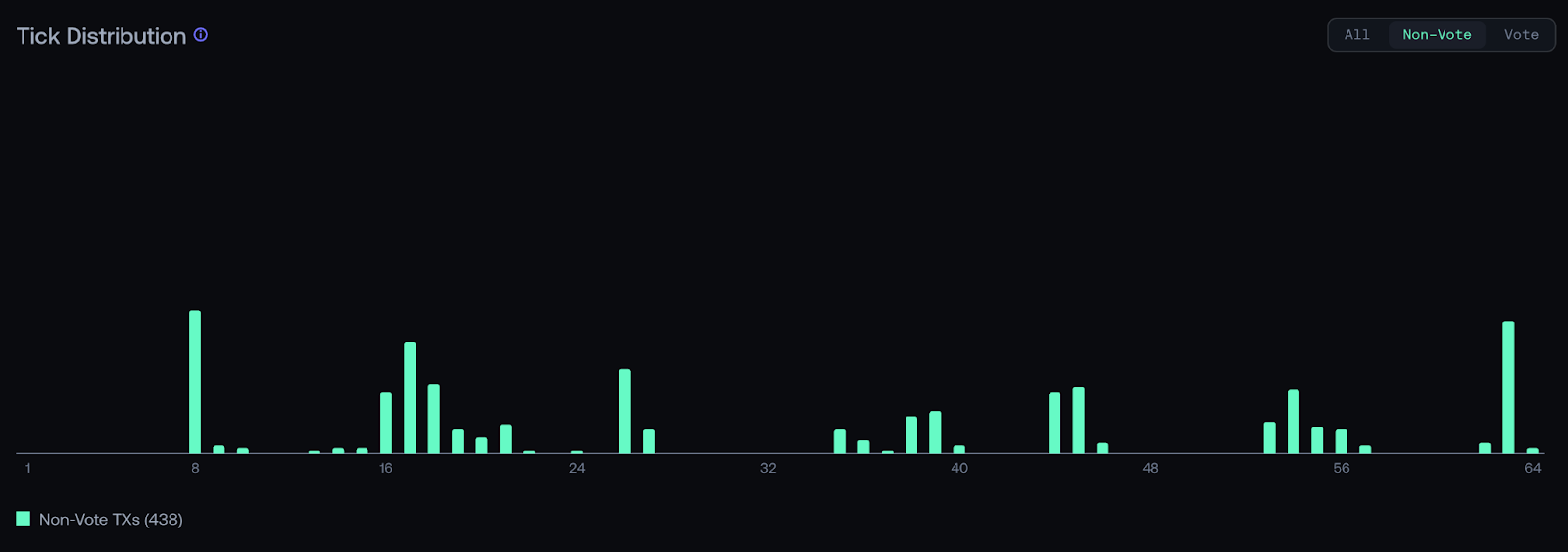
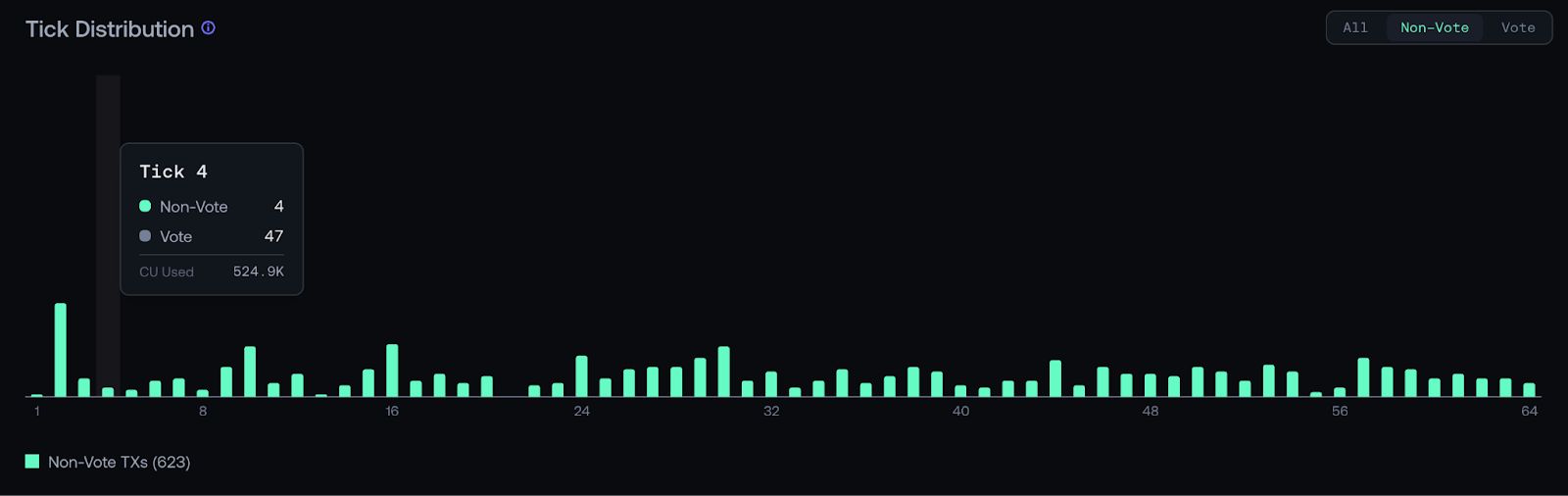
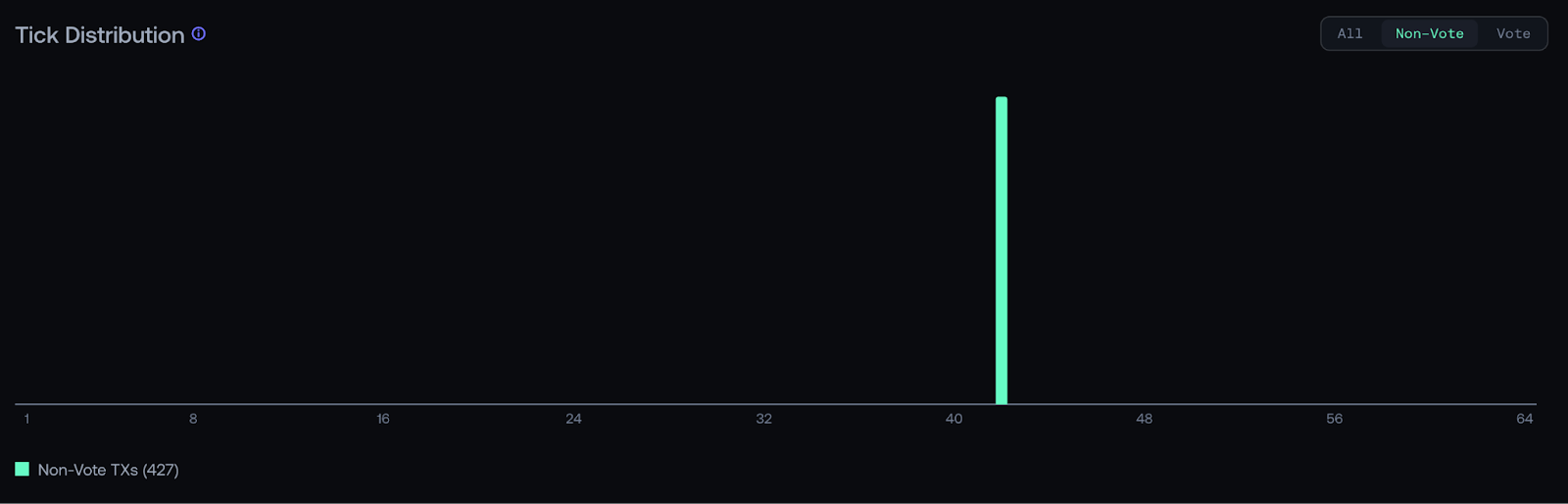
In the worst scenarios, certain scheduler configurations create conditions where block producers can frontrun or extract value from the same transactions they are responsible for executing. In more extreme cases, this dynamic creates incentives to selectively exclude transactions altogether.
The risk isn't hypothetical—it's a known property of any system where a single party controls ordering without constraints or transparent standards. As Chris from Ergonia puts it: “If one firm can control economic activity when it matters, it’s functional centralization. And that’s the effect we want to avoid on Solana that occurs when self-interested parties can control block order fully.”
All in all, important metrics for market makers, such as markouts, transaction latencies, and costs, are subject to change every 1.6 seconds depending on factors such as the validator, the scheduler, region, networking, and volatility. Prop AMMs lack the deterministic guarantees that are essential to competitive market making. This lack of determinism adds friction, and in the status quo we’ve observed it negatively affects onchain price discovery and the rest of the market.
“If we start having validators behaving like a trading team, where they are optimizing for MEV, maximally extractable value, that is obviously not a good outcome.” – SpaceMonkey, ZeroFi
Unpredictable games produce worse outcomes
The current multi-client market infrastructure produces a market environment where execution is inconsistent, opaque, and non-deterministic. These properties are opposite to market making in traditional finance where market makers have an extremely high degree of certainty when their transactions will land and how much it costs. Issues that arise on Solana include higher levels of toxic flow, the risk of censorship, and other types of cat-and-mouse games, all of which undermine decentralization–the quintessential property of DeFi
Even though Solana is much further along than all major L1s, existing market structures and activities are insufficient for competing with traditional financial market infrastructure, CEXes, and market-making specific chains. Spreads can get tighter, liquidity can get deeper, Solana can onboard more assets and users.
“The more of this client diversity is the case, the more market makers have less predictable ability to land transactions and the wider spreads become in general.” - Chris, Ergonia
Why This Is Really Important for Solana
This isn't just a problem for market makers. It's a problem for all of Solana DeFi.
If market making on Solana remains structurally unpredictable from leader to leader, they'll only do it with wider spreads, or the best firms will flock to other chains. Retail traders get worse prices. Protocols lose volume to CEXs or application-specific chains tailored for market making. Users flow gets routed to venues that offer better prices. And Solana risks letting another ecosystem deliver Internet Capital Markets.
The irony is that Solana has all the raw ingredients to be the best venue for price discovery in crypto. It's fast, it's cheap, it has real battle-tested throughput, and it has proven to successfully scale the most robust onchain spot trading markets in all of crypto, year after year. For prop AMMs specifically, with more deterministic mechanisms and other tools that improve their market making, they can more effectively provide their alphas to the market, avoid losses to toxic flow, and tighten spreads for non-toxic users.
If we want Solana to win, we must build infrastructure that fosters tighter spreads and more competitive execution quality for users. This means building infrastructure that supports market makers.
What Comes Next
The data and feedback from some of crypto’s best market makers highlight these problems. They’ve signaled to us that there are still insufficiencies in the current market structure, but they are fixable. The gap isn't in the Solana protocol or in the sophistication of its participants. It's in the coordination layer between the applications providing services to users and the validators processing their transactions.
At Jito, we’re building Solana’s coordination layer, and we think about these problems every day. We believe the next major unlock for market makers and other financial applications in globally distributed finance is next generation infrastructure that deterministically gives them meaningful control and flexibility over how their transactions are executed. Neutral infrastructure that makes the rules of the game transparent, consistent, and predictable, so that market makers can focus on quoting tighter, taking on more risk, and competing to provide users the best possible prices for all assets, in every slot.
We're building infrastructure that coordinates the future of global price discovery on Solana. More soon.
“BAM is important because it generally is aligned with the long-term interest of keeping the Solana ecosystem healthy and thriving for the long term so that we can have an ecosystem where people can build many billion-dollar businesses.” – Chris, Ergonia
Check out the first episode of the BAM Builder Series featuring Ergonia, and stay tuned for more!