System architecture, validator flow, and operational basics.
BAM Documentation
BAM builds on top of existing Solana validator infrastructure (Agave and Jito-Solana) with enhanced trust + performance.
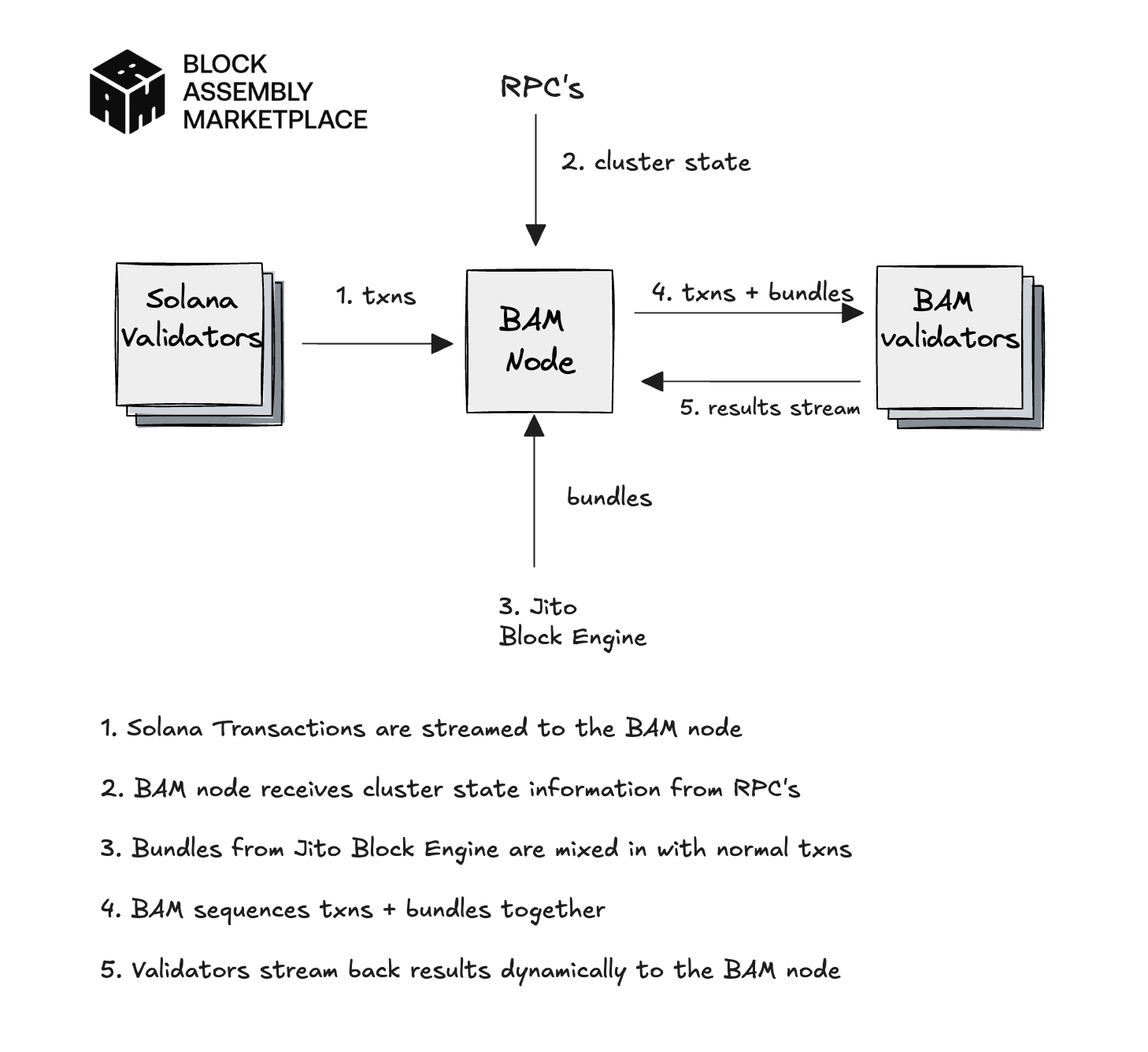
It introduces a dedicated BAM Node and a lightweight BAM Client that connect to validators via gRPC and QUIC, as shown below.
The BAM System facilitates transaction scheduling on the Solana Network.
- BAM Node: Ingests Bundles/Transactions, Solana cluster state and current leader state. Validates, sequences and finally sends the Bundles/Transactions to the leader BAM Validator. Receives execution results back and updates its local awareness of everything as best as possible. A BAM Node can serve multiple BAM Validators.
- BAM Validator(s): Receives and executes a transaction stream received from the BAM Node. Receives Leader State messages and transaction execution results. A BAM Validator can connect to only one BAM Node at a time.
- Block Engine: Existing Jito Labs infrastructure that provides Packet and Pre-Simulated Bundle streams to Solana Validators. The BAM Node creates one connection to the Block Engine in lieu of each connected validator in order to maintain backwards compatibility.
BAM Node
The BAM Node core functional requirements:
- Shall receive Transactions and Bundles and validate them according to Solana network standards, combined with the most recent available state.
- Shall not permit invalid transactions into the scheduled sequence.
- Shall Sequence transactions according to programmatic, stable rules.
- Send transactions out to a confirmed, connected validator when their leader rotation arrives.
Validator
The BAM Validator is responsible for upholding the following contract:
- Execute all received transactions in that exact order
- Provide correct execution feedback and state information.
If any of the above are violated, the BAM Node reserves the right to temporarily or permanently disconnect the BAM Validator.
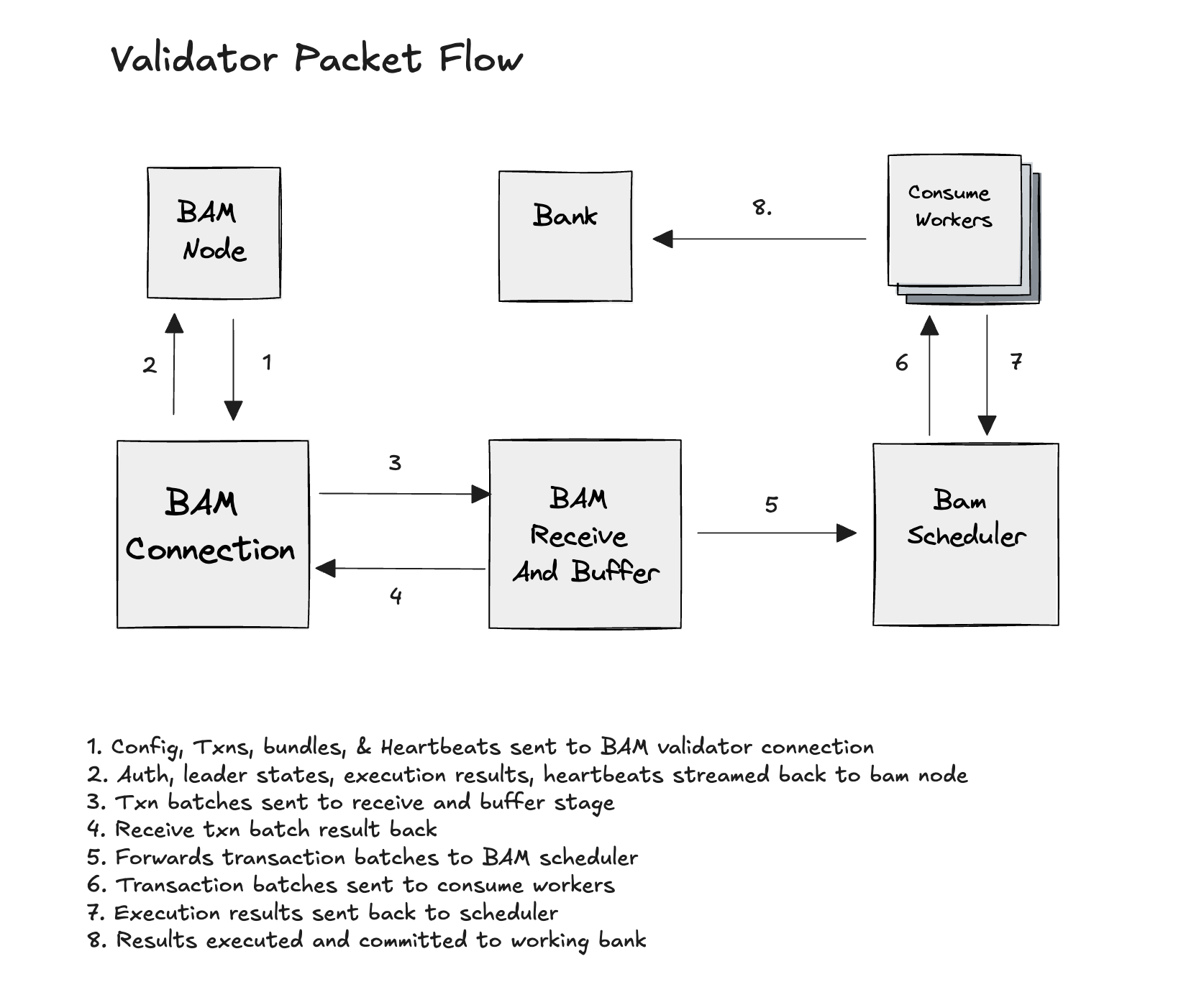
The following diagram illustrates the general flow of messages, transactions, and data within the BAM Validator implementation.
FAQ's
How do I migrate from the Jito-Solana client to BAM?
- All existing Jito flags and features are retained.
- Add the
--bam-urlflag pointing to the generic BAM Node URL. - No other CLI syntax changes are required.
See https://bam.dev/validators/ for more information.
Can I run BAM on my existing hardware?
Yes. Your existing validator running jito-solana is sufficient to run AgaveBAM, or your existing Firedancer validator is sufficient to run FireBAM. No equipment upgrades are required.
Does BAM work with Jito Bundles?
Yes, AgaveBAM and FireBAM sequence both normal transactions and Jito Bundles.
Does BAM affect my JitoSOL rank or SFDP delegation?
- JitoSOL rank: AgaveBAM and FireBAM do not directly affect your rank unless downtime occurs.
- Vote credits: Unaffected — AgaveBAM and FireBAM do not interfere with vote production.
- SFDP delegation: AgaveBAM and FireBAM do not impact SFDP eligibility as long as you're running a compatible Jito client version.
Does BAM currently support Firedancer?
Yes, FireBAM supports Firedancer. See https://bam.dev/validators/#firebam for more information.
How does BAM interact with transactions sent via RPC or directly to TPU?
- RPC flow: If your validator is connected to BAM and scheduled to be a leader soon, transactions submitted via RPC are routed through BAM.
- Direct TPU flow: Transactions sent directly to your TPU port are processed through BAM before execution.
Can I run BAM with a hot spare validator?
Hot spare configurations should work normally, similar to Jito-Solana and Agave setups. However, you need to manually re-run set-bam-url after switching over to a hot spare to ensure that the connection connects with the correct leader. You may see this in the logs otherwise:
Example log output:
4 [2025-10-24T17:38:12.279721584Z ERROR solana_core::bam_connection]
  Failed to receive message from inbound stream:
  Status {
    code: PermissionDenied,
    message: "Validator is not on the leader schedule",
    source: None
  }